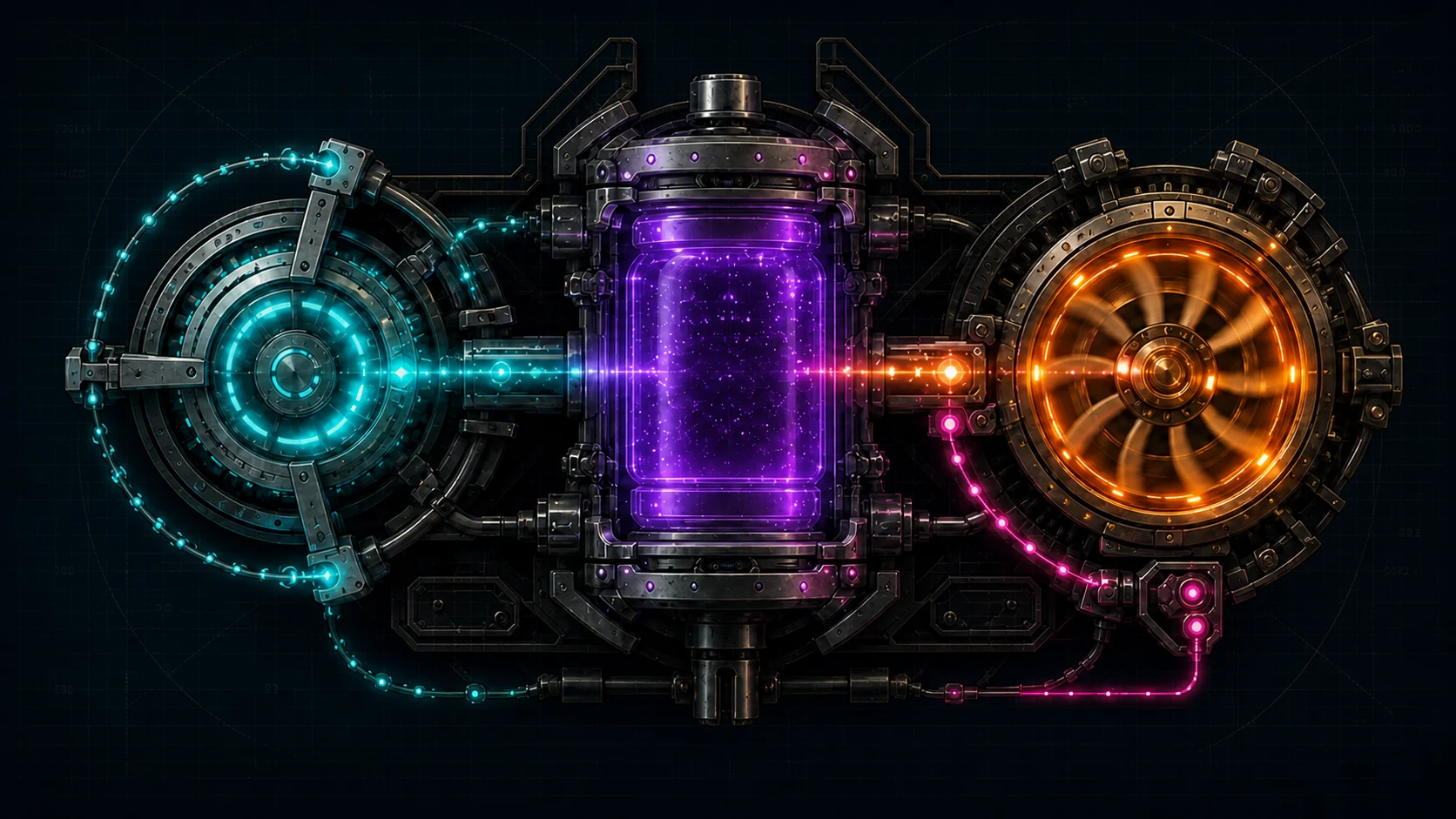
ARC//FORGE
A systems-engineering game where the player discovers automation by first feeling the cost of repetition.
Explore the projectI turn ideas into tested software, physical systems, images, games, and practical workflows—using AI to move faster without handing it the final say.
AI can widen what one person is capable of building.
It does not remove the need to choose the right problem, set constraints, or reject a convincing mistake.
The portfolio is the evidence trail: idea, direction, implementation, failure, correction, and result.
A systems game, a private family platform, an evidence-led music studio, and a beginner AI workshop. Each record distinguishes what exists from what is still being tested.

A systems-engineering game where the player discovers automation by first feeling the cost of repetition.
Explore the projectA multiplayer family game system with private hands, host controls, recovery, role boundaries, and a seatless living-room display.
Explore the projectSeparate Clarinet and Guitar curriculum packs share one evidence engine while keeping each learner and instrument’s progress distinct.
Explore the project
A patient, in-person beginner workshop that uses familiar surroundings and real projects to make AI feel practical rather than intimidating.
About the workshopPrinted parts, moving mechanisms, and cedar builds. Each record pairs the visuals with what was made, what was tested, and what still needs work.

Active prototypes
The v0.5 whale now has a display platform and nameplate, with new photos and close-up mechanism footage.
AI-retouched presentationSee the build record
Active prototypes
The real printed assembly makes the next design problem visible.
AI-retouched presentationSee the build record
Released work
Measured constraints become physical cedar covers and planters.
AI-retouched presentationSee the build recordGood automation still needs clear intent, accurate inputs, tight constraints, and review. The goal is to ship useful systems and assets without letting speed replace judgment.
Start with the outcome the artifact must create—not the model, app, or feature that sounds impressive.
Identify authoritative references, real constraints, damaged inputs, assumptions, and what remains unknown.
Use AI to accelerate exploration, reconstruction, coding, documentation, and production while preserving human control.
Run the software, install it on the device, print the part, show it to a user, or put the result into the environment it must survive.
Preserve failures, explain limitations, record what was actually verified, and ship only what the evidence supports.
This design began as an AI-assisted pilot. Brian set the direction, supplied reference material, tested versions, and approved the V6 design. The site now uses shared source files, with browser testing and owner feedback shaping the implementation.
The result demonstrates the same operating rule as the projects: conversation can accelerate production, but ownership, judgment, and publication authority stay human.
Explain the audience, goal, constraints, and desired experience in ordinary language.
Turn the conversation into working copy, visuals, code, and interactions.
Open it in a browser, use it, compare it, and expose what did not work.
Keep the useful result, revise the misses, and publish only after human review.
One place to understand the breadth of the work. Public pages open directly; private and unfinished systems are labeled instead of being disguised as launches.
A local library for finding past conversations and carrying selected context into the next task.
Evidence and limits in project recordA private implementation that keeps proposed changes separate from the authority to accept them.
Evidence and limits in project record
A working local transcription tool with source-linked screenshots, review decisions and portable context packs.
Evidence and limits in project recordArchitecture and interface experiments for taking a project from brief through production, review and delivery.
Evidence and limits in project recordA portable-context format experiment for keeping source material, instructions and interpretation together.
Evidence and limits in project recordAnswer-engine monitoring that saves dated evidence and separates observed results from unavailable checks.
Evidence and limits in project record
A systems-thinking game prototype shaped through experimentation, interface repair and physical iPad feedback.
Evidence and limits in project recordA Minecraft Bedrock add-on prototype exploring hatching, bonding, training and persistent creature companions.
Evidence and limits in project record
A native iOS game pilot refined through simulator work and focused physical iPhone tests.
Evidence and limits in project recordA private multiplayer card game with separate player, host and shared-display roles.
Evidence and limits in project recordA private Roku and MediaBridge integration with progress, Resume and Continue Watching behavior.
Evidence and limits in project recordA local practice studio with separate learning paths and a swing-focused return-to-clarinet program.
Evidence and limits in project record
An outdoor lighting prototype combining physical placement, independent light behavior and ESP32 control.
Evidence and limits in project record
A hand-cranked skeletal whale with moving waves, now in the v0.5 display build with a platform and nameplate. Physical tests are refining fit, spacing and assembly.
Evidence and limits in project record
A printed teaching model links a rolling stone and internal bed motion. Real assembly revealed a cord-routing problem now driving the next drum revision.
Evidence and limits in project recordCat-reference studies, kit experiments and miniature concepts explore recognizable shape, separate color parts and small-scale storytelling.
Evidence and limits in project record
Three custom cedar covers and planters turn awkward post-and-bracket constraints into removable wooden assemblies. Completion and pickup are owner-reported.
Evidence and limits in project recordAdapters, pins, clips and spacers turn measured problems into small print tests, with digital checks kept separate from a proven physical fit.
Evidence and limits in project recordReference-led demonstrations compare AI imagery, identify factual or visual errors, and turn human critique into specific corrections.
Evidence and limits in project recordPhotography, careful masking and AI-assisted image studies meet in a workflow where the actual product remains the reference.
Owner-reportedOwner-reported account service, merchandising and field coordination connect planning with the practical work at each stop.
Evidence and limits in project recordWeddings, portraits, events and product work build the visual judgment behind Brian’s approach to directing and reviewing images.
Owner-reported
A paper-trading research experiment uses finite hypothesis campaigns and failure gates. The reviewed work did not demonstrate an income-producing strategy.
Evidence and limits in project record
An offline prototype estimates a print order using full plates, retry allowance, labor, operating costs, selling fees and target margin.
Evidence and limits in project recordPrivate application pages and readable resumes connect a role’s requirements with existing work. A proposed generator remains a separate future idea.
Evidence and limits in project recordA planned small workshop for adults who want practical AI experience, clear checks and a place to ask ordinary questions.
Evidence and limits in project record
The first education offer is intentionally small: an in-person Oxnard workshop where beginners bring an everyday problem, learn to add context, inspect the answer, correct it, and know when to verify.
I did not begin as a traditional software engineer. I began with problems I wanted to solve and projects I wanted to build. The site should make that journey legible: not “trust me, I know AI,” but “here is the artifact, here is what failed, here is what changed, and here is what actually works.”
The public pages remain useful on their own. The redesign gives them one shared identity, one navigation system, one status language, and one honest way to distinguish finished work from active prototypes and research.
This redesign is itself an AI-assisted case study: a conversational brief became a working pilot, then changed through direct browser testing and owner feedback before any live update was allowed.
For AI-assisted workflows, visual production, documentation, product experiments, or beginner AI education.